


How BUSY Keeps Up with GST Law Changes - Auto Updates Explained
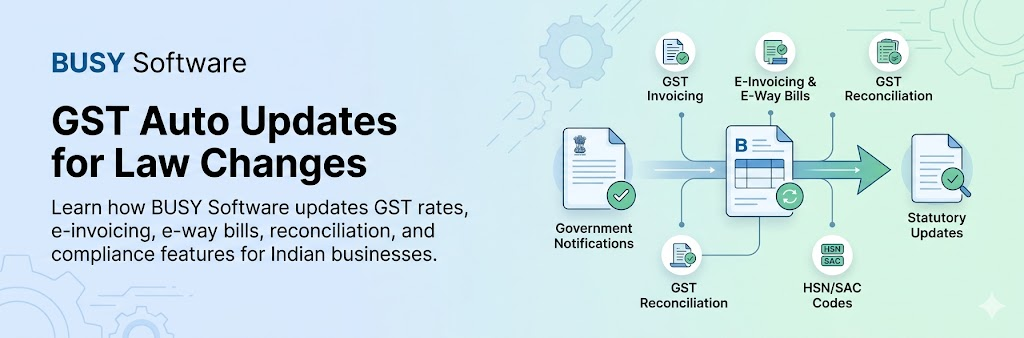
GST rules in India keep changing. Rates change, return formats change, e-invoicing rules change, and e-way bill rules also get updated. For business owners, accountants, and tax professionals, manually tracking every notification is not easy.
This is where accounting software becomes important. BUSY helps Indian businesses manage GST compliance with regular software updates and built-in GST features, including GST invoicing, e-invoicing, e-way bills, GST reconciliation, GSTIN validation, and GST reports.
This article explains how BUSY helps businesses stay up to date with GST law changes in a simple, practical way.
Key Takeaways
- GST rules in India change frequently, including GST rates, e-invoicing rules, e-way bill rules, and return formats.
- BUSY provides product and statutory updates to help users stay aligned with these changes.
- Users can check updates from the Company Menu > Check BUSY Updates.
- BUSY supports GST invoicing, GST filing, e-invoicing, e-way bills, GST reconciliation, and GSTIN verification.
- The 2025 e-way bill document age rule took effect on 1 January 2025.
- The 30-day e-invoice reporting rule applies to taxpayers with an AATO of ₹10 crore or more from 1 April 2025.
- BUSY can reduce manual GST work, but businesses should still keep the software up to date and verify their GST settings.
Why GST Law Changes Matter for Businesses
GST is not a one-time setup. Since GST was introduced in India, businesses have seen many changes in rules, formats, rates, and portal requirements.
- GST rate revisions
- HSN/SAC code updates
- E-invoicing threshold changes
- E-way bill rule changes
- GSTR return format updates
- GST reconciliation requirements
- GST portal and e-invoice/e-way bill portal security changes
If a business does not update its billing and accounting system on time, it may issue invoices with wrong GST rates, miss e-invoice deadlines, generate incorrect e-way bills, or face reconciliation mismatches.
That is why using updated GST accounting software is important
What Can Go Wrong If GST Updates Are Missed?
GST mistakes can create real business problems.
| Compliance Issue | Possible Impact |
|---|---|
| Wrong GST rate on invoice | Incorrect tax collection, buyer ITC issue, possible correction work |
| Wrong HSN/SAC code | Mismatch in GST reports or scrutiny risk |
| Missing e-invoice | Invoice may not be valid where e-invoicing is mandatory |
| Late e-invoice reporting | IRN generation may be blocked for eligible taxpayers |
| Wrong e-way bill details | Goods movement may face detention or penalty |
| ITC mismatch | ITC claim may need correction or follow-up |
| Late GST return filing | Late fee, interest, and compliance burden |
How BUSY Helps with GST Updates
BUSY helps businesses in two ways:
- Software and statutory updates
- Built-in GST compliance features
These two work together. Software updates help BUSY stay aligned with new rules, while built-in features help users manage daily GST work
BUSY Software Updates
BUSY releases software updates and statutory updates when changes are required. These updates may include GST-related changes, product improvements, bug fixes, new reports, and statutory compliance updates.
How to Check BUSY Updates
- Take a backup of your company data.
- Open BUSY.
- Go to the Company Menu.
- Click Check BUSY Updates.
- Download product and statutory updates.
- Install the update files as instructed.
It is important to take a backup before updating the software because business accounting data should always be protected before installing any update.
BUSY GST Features
BUSY supports many GST features such as GST filing and returns, e-way bills, e-invoices, GST reconciliation, and GSTIN verification. GST-registered businesses can use these features to reduce manual work and improve GST compliance control.
E-Invoicing in BUSY
E-invoicing is mandatory for businesses whose aggregate turnover crosses the prescribed limit. The e-invoice mandate currently applies to businesses with AATO of ₹5 crore and above from 1 August 2023.
BUSY supports auto e-invoice generation in GST-focused editions such as Saffron and Emerald. This can help businesses generate e-invoices without manually entering the same data again on the portal.
BUSY can help with:- E-invoice generation
- IRN generation process
- QR code on e-invoice
- E-invoice data linked with the original transaction
- Reduced manual data entry
2025 E-Invoice Reporting Rule
From 1 April 2025, taxpayers with AATO of ₹10 crore and above cannot report e-invoices older than 30 days from the invoice date. This applies to invoices, credit notes, and debit notes for which IRN is required.
This makes timely e-invoice generation very important. BUSY can help by allowing businesses to generate e-invoices close to the time of invoice creation.
E-Way Bill Support in BUSY
E-way bills are required for the movement of goods when the value exceeds the prescribed limit. BUSY supports e-way bill generation and helps reduce manual work for businesses that regularly move goods.
- E-way bill generation from invoices or challans
- Transporter details
- Vehicle details
- E-way bill data handling
- Bulk work for businesses with many dispatches
2025 E-Way Bill Rule Changes
From 1 January 2025, e-way bills can be generated only for documents dated within 180 days. E-way bill extension is also limited to 360 days from the original date of generation.
So businesses should make sure their document dates are correct before generating e-way bills.
GST Reconciliation in BUSY
GST reconciliation is one of the most important parts of GST compliance. Businesses need to compare purchase records with supplier-filed data and check whether ITC is correctly available.
BUSY supports GST reconciliation features such as:- GSTR-2A reconciliation
- GSTR-2B reconciliation
- GSTR-1 reconciliation
- GSTR-3B comparison
- Voucher-wise reconciliation
- Party-wise reconciliation
GST Rate Changes and BUSY
GST rates can change after GST Council meetings. In 2025, major GST rate changes were announced and many revised rates were implemented from 22 September 2025.
BUSY users should update the software and statutory updates whenever major GST rate changes are announced.
After updating, businesses should review:
- Item master GST rates
- HSN/SAC codes
- Sales invoice formats
- Purchase entries
- GST reports
- Tax calculation settings
This helps ensure that future invoices use the correct GST rate.
GSTIN and HSN/SAC Validation
BUSY supports GSTIN and HSN/SAC validation in GST-focused workflows. This helps businesses reduce errors while creating parties, items, invoices, and GST reports.
This can help prevent:- Wrong GSTIN entry
- Invalid party details
- Wrong HSN/SAC usage
- GST reporting errors
- ITC-related mismatch issues
MFA and Portal Security
MFA or 2FA is mainly a security requirement for login on the e-invoice and e-way bill systems. It is not something that BUSY can fully handle automatically because it depends on government portal login and authentication rules.
BUSY can support GST workflows, but users must keep their GST portal, e-invoice portal, and e-way bill portal credentials updated. They should also make sure that the registered mobile number is active for OTP or MFA.
A safer way to understand this is simple: BUSY helps users manage GST workflows, but portal-level MFA or OTP requirements must be completed by the user as per government portal rules.
BUSY Editions and GST Features
BUSY has different editions for different business needs. Feature availability depends on the edition.
| Feature | BUSY Express | BUSY Blue | BUSY Saffron | BUSY Emerald |
|---|---|---|---|---|
| Basic accounting | Yes | Yes | Yes | Yes |
| Billing | Yes | Yes | Yes | Yes |
| Inventory | Basic | Yes | Yes | Yes |
| GST invoicing | Basic | Basic | Advanced | Advanced |
| Software updates | Yes | Yes | Yes | Yes |
| E-invoicing | No | No | Yes | Yes |
| E-way bill | No | No | Yes | Yes |
| GSTR reconciliation | Limited | Limited | Yes | Yes |
| Direct GSTR-1/IFF upload | No | No | Yes | Yes |
| Multi-GSTIN management | No | No | No | Yes |
| Multi-branch management | No | No | No | Yes |
| Payroll | No | No | No | Yes |
Which BUSY Edition Is Better for GST Compliance?
For a non-GST or very small business, BUSY Express or BUSY Blue may be enough.
For a GST-registered business, BUSY Saffron is usually more suitable because it includes GST-specific features such as e-invoicing, e-way bills, GSTR reconciliation, and GST return-related workflows.
For businesses with multiple branches, multiple GSTINs, payroll, or approval workflows, BUSY Emerald is more suitable.
How BUSY Helps During GST Rate Changes
Suppose a trader sells products whose GST rate changes after a GST Council update. Without updated software, the trader may need to manually check the new rate, update every item, and verify each invoice. This can take time and may lead to errors.
With BUSY, the user can:- Check and install the latest BUSY update.
- Review statutory updates.
- Update item GST rates.
- Check HSN/SAC details.
- Generate invoices with updated tax settings.
- Review GST reports before filing.
This reduces manual work and helps the business stay aligned with current GST rules.
Frequently Asked Questions
How often should I update BUSY?
You should check for BUSY updates regularly, especially after GST rate changes, GST
Council meetings, or major government notifications. A good practice is to check updates at
least once every quarter and before important GST filing periods.
Does BUSY automatically apply GST law changes?
BUSY provides software and statutory updates, but users should still install updates and
review settings. For GST rate changes, users should check item masters, HSN/SAC codes,
and sample invoices before continuing regular billing.
Does BUSY support e-invoicing?
Yes. BUSY supports auto e-invoicing in GST-focused editions such as Saffron and Emerald.
This helps businesses generate IRN and e-invoice details from the software.
What is the 30-day e-invoice reporting rule?
From 1 April 2025, taxpayers with AATO of ₹10 crore and above cannot report e-invoices
older than 30 days from the invoice date. This applies to invoices, credit notes, and debit
notes where IRN is required.
Does BUSY support e-way bills?
Yes. BUSY supports e-way bill generation. Businesses should still ensure that document
dates, transporter details, vehicle details, and GST details are correct before generating
e-way bills.
Does BUSY handle MFA automatically?
No. MFA or 2FA is a portal-level security requirement. BUSY can support GST workflows,
but users must complete MFA or OTP requirements on the relevant government portals as
required.
Which BUSY edition is best for GST-registered businesses?
BUSY Saffron is suitable for GST-registered businesses that need e-invoicing, e-way bills,
GST reconciliation, GST returns, and GST validation features. BUSY Emerald is better for
businesses that also need multi-branch and multi-GSTIN management.
Is BUSY’s free trial 30 days?
No. BUSY’s official trial page mentions a 15-day free trial. So the blog should not mention a
30-day free trial.
Conclusion
GST rules in India keep changing. Businesses need to stay updated with GST rates, e-invoicing rules, e-way bill rules, reconciliation requirements, and portal security requirements.
BUSY helps by providing software updates, statutory updates, and GST features such as GST invoicing, e-invoicing, e-way bills, GST reconciliation, GSTIN validation, and reports. However, BUSY users should still follow a simple process: keep the software updated, take backups before updates, review item GST rates, check HSN/SAC codes, reconcile GST data, and keep government portal credentials active.
For GST-registered businesses, BUSY Saffron can be a practical choice. For businesses with multiple branches or GSTINs, BUSY Emerald can be more suitable.
