

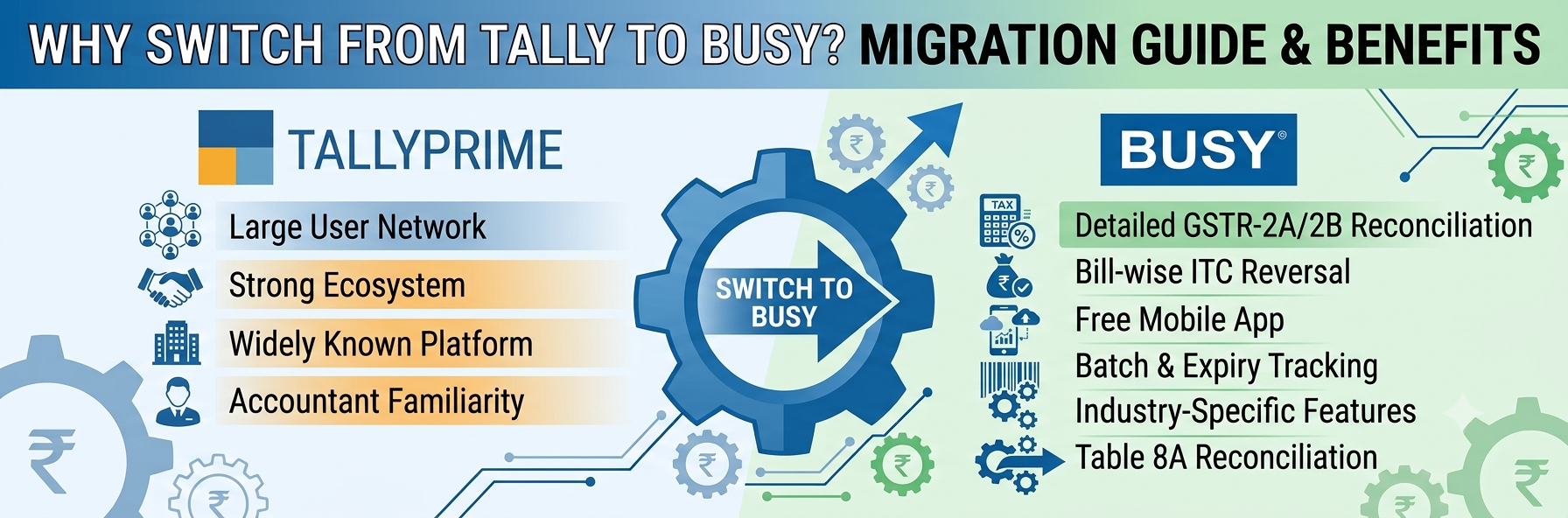
Why Switch from Tally to BUSY? Migration Guide and Benefits
Tally has been widely used by Indian businesses for accounting, GST work, invoicing, and regular business reports. Many accountants are familiar with it, and for several businesses, it continues to handle daily bookkeeping and compliance work well.
But business needs change as companies grow. A company that once needed only ledger posting and invoice creation may later need better GST reconciliation, branch-wise visibility, detailed inventory tracking, user controls, mobile access, payment follow-ups, and faster reporting. That is when many businesses start comparing Tally and BUSY.
The decision is not about saying one software is good and the other is not. Tally and BUSY both support important accounting and compliance workflows. The real question is whether the current system still supports the way the business works today.
This guide explains why businesses consider switching from Tally to BUSY, where BUSY may fit better, and what to check before migration. BUSY has been supporting Indian businesses for 30+ years and is trusted by 6,00,000+ businesses with accounting, GST, inventory, billing, and business management.
Key Takeaways
- Businesses usually consider BUSY when GST reconciliation, inventory tracking, billing, reporting, or user controls become more detailed.
- Tally and BUSY both support core accounting and compliance workflows, so the decision should be based on business fit.
- BUSY may be more practical for SMEs that need deeper GST views, inventory controls, mobile access, and workflow controls.
- BUSY has supported Indian businesses for 30+ years and is trusted by 6,00,000+ businesses across accounting, GST, inventory, billing, and business management.
- Before migration, businesses should take a backup, check compatibility, and verify data after transfer.
Why Businesses Compare Tally and BUSY
Most businesses do not look for a Tally alternative because Tally has stopped working for them. They usually start looking because their business has become more complex. A growing business may have more GSTINs, branches, users, stock locations, billing, and reporting needs. It may also need better control over who can enter, edit, approve, or view data.
For example, a retailer may need faster billing and better stock visibility. A distributor may need batch-wise or MRP-wise tracking. A manufacturer may need job work and production reports. A multi-user business may need stronger data controls, user hierarchy, and data freezing. In such cases, the question is not only: “Can the software do accounting?” The better question is: “Can the software support the way the business now works?”
This is where BUSY becomes relevant for many Indian SMEs. It may be better to switch from Tally to BUSY when a business needs more than accounting entries and standard reports, especially when daily work involves GST matching, detailed stock tracking, counter billing, multiple users, branch-level visibility, or regular follow-ups. The sections below compare these needs one by one.
Tally vs BUSY: Comparison by Business Need
GST Reconciliation and Filing
Tally supports GST reports, return-related data, e-invoicing, e-way bills, and reconciliation workflows. For businesses with straightforward GST work, this may be enough. BUSY becomes more useful when GST work needs deeper checking. Businesses that regularly compare books with GSTR-2A, GSTR-2B, and GSTR-3B may find BUSY’s GST-focused dashboards and reconciliation views more practical.
BUSY helps users review mismatches, ITC status, party-wise differences, filing-related data, and reconciliation reports from within the system. This can reduce dependence on separate spreadsheets, especially for businesses where GST matching is a regular monthly task. For businesses where GST errors can affect ITC claims, filing accuracy, and cash flow, this extra visibility can make a real difference.
Billing and Invoicing
Tally can manage regular invoicing and GST billing for many businesses. It works well where invoice formats, billing flows, and customer transactions are simple. BUSY may suit businesses that need more billing flexibility at the counter, branch, or trade level. BUSY adds more billing support through barcode and QR-based billing, regional-language invoice printing, party history, last transaction view, WhatsApp sharing, and item-wise discounts.
This is useful for retailers, distributors, FMCG traders, pharma businesses, grocery stores, garments shops, electronics dealers, and similar SMEs where billing speed and transaction details matter. Instead of treating billing as only invoice creation, BUSY helps connect billing with stock, customer history, discounts, payment follow-ups, and reporting.
Inventory Management
Basic stock tracking may be enough when a business only needs item-level quantities and values. But inventory becomes harder when the business deals with batches, MRP, serial numbers, warranty, sizes, variants, material centres, or customer-specific item codes.
Tally can support inventory workflows, but businesses with more detailed stock needs may require more advanced controls. This is where BUSY may be a stronger fit. It supports inventory tracking across batches, serial numbers, warranty details, MRP, item parameters, sizing, material centres, and party-wise item codes.
For businesses where inventory directly affects billing, purchase planning, customer service, and margins, this difference can matter more than basic accounting features. It also reduces the need for separate registers or manual stock checks, which often become difficult as the product range grows.
Job Work and Manufacturing
Tally can support accounting and inventory for many trading and manufacturing businesses. However, businesses involved in job work or production may need more than purchase, sale, and stock reports. They may need to track raw material usage, finished goods, wastage, job IDs, material movement, production variance, and job work accounting.
BUSY is useful for businesses where production and accounting need to work together. It supports BOM details, production planning, production variance reports, raw material tracking, job tracking, and posting of job work in accounts.
This makes BUSY more practical for manufacturers, job workers, and businesses that need clearer links between stock movement, production activity, and financial records.
User Control and Administration
Tally supports user access and security controls, which may be enough for smaller teams. But as more users, branches, and departments start working on the same system, businesses often need tighter control. A billing user, purchase user, accountant, branch manager, auditor, and owner may not need the same access.
BUSY is useful in such cases because it supports user hierarchy, data freezing, login controls, custom validations, and other administrative checks. This helps businesses control who can enter, edit, approve, validate, or view specific data. For SMEs with multiple users or locations, these controls can reduce mistakes and improve accountability.
Mobile Access and Daily Visibility
Business owners and managers are not always sitting in front of the office system. They may need to check sales, receivables, payables, stock, ledgers, or reports while travelling or working away from the office.
Tally offers remote and cloud access options for businesses that need to view or work on data outside the office setup. BUSY also provides mobile access for key business tasks and reports. Users can create quotations, orders, invoices, receipts, and payments. They can also view reports, check ledgers, track stock, and share invoices, ledgers, and reports through WhatsApp, SMS, or email.
This is useful for owners and managers who need quick visibility without waiting for office reports. For businesses comparing the two, the key point is to check how each setup fits daily work, especially for reports, approvals, billing, and follow-ups.
What Changes After Moving to BUSY?
After moving from Tally to BUSY, the change is not only about using a different accounting software. The bigger shift is in how daily work is organised. The major BUSY software benefits are that instead of handling accounting, GST checks, billing, stock updates, reports, and follow-ups as separate tasks, businesses can manage more of these activities from one connected system.
This can make daily operations easier for teams that depend on the same data. The accounts team, billing users, inventory team, and business owner can work with clearer information instead of relying on repeated manual updates or separate files. This helps reduce gaps between what is recorded, what is reported, and what is actually happening in the business.
That is why the move from Tally to BUSY should be seen as a workflow decision, not just a software replacement. The value is not only in shifting data from one system to another, but in improving how the business tracks, reviews, and controls its work after migration.
Brief Migration Process from Tally to BUSY
ort, the process works through the Tally2BUSY utility. The basic flow is:
- Take a backup of Tally data.
- Download and install the Tally2BUSY utility.
- Create a new company in BUSY.
- Open the required company data in Tally.
- Map account groups correctly in the utility.
- Transfer the data into BUSY.
- Verify the transferred data before live use.
The utility can transfer both master data and transaction data from Tally to BUSY. Businesses can also choose a selected date range if they do not want to move all historical records. However, migration should not be treated as a one-click job without review. Data quality, group mapping, compatibility, and post-transfer checking are important.
What Should Be Checked After Migration?
Accounting software migration should not end at data transfer. Verification is equally important. Many businesses also run Tally and BUSY in parallel for a short period. This helps compare figures and build confidence before fully moving daily work to BUSY. After migration, businesses should check whether the balances are reconciling. This step is important because even small errors in mapping or opening balances can affect reports later. Some things to check:
- Trial balance
- Opening balances
- Party ledgers
- Sales vouchers
- Purchase vouchers
- Journal vouchers
- GST ledgers
- Stock items
- Stock balances
- Outstanding receivables and payables
- Key financial reports
- GST-related reports
Conclusion
The decision to move from Tally to BUSY should not be based on a simple claim that one software is better than the other. Tally is widely used and capable for accounting, GST, billing, and reporting. The real question is whether the current setup still supports the way the business works today.
If GST reconciliation takes too much manual effort, inventory needs more detail, billing needs more flexibility, or multiple users need stronger controls, BUSY can be a practical Tally alternative for Indian SMEs.
BUSY offers deeper workflow support for businesses that need accounting, GST, inventory, billing, production, and administration to work more closely together. The Tally2BUSY utility can also help transfer master and transaction data, but businesses should still back up, review, and verify their records before fully shifting daily work.